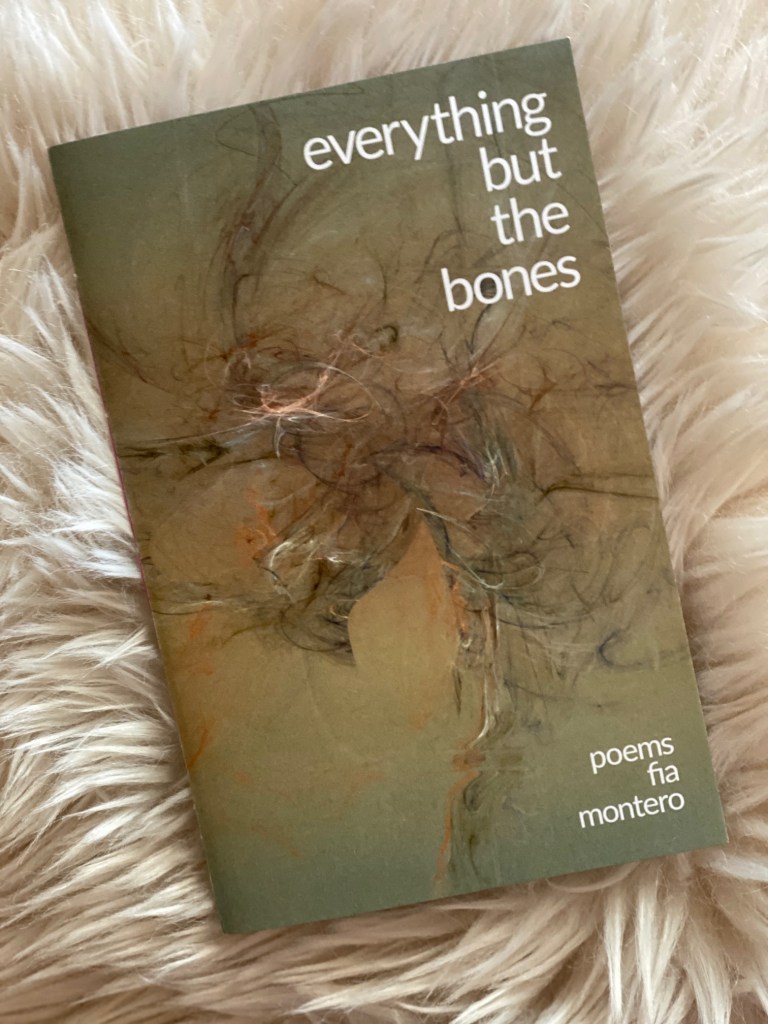
Fia Montero is a writer based in Des Moines, Iowa. She holds a BFA in Art and Design from Iowa State University, and a BSHS in Health Science from Mercy College of Health Sciences. She is the author of the chapbook Everything but the Bones (Seven Kitchens Press, 2025). Her work has also appeared in Harbor Review, Passengers Journal, The Minnesota Review, and others.
Fia Montero’s Everything but the Bones is a striking debut chapbook that feels both ephemeral and enduring — like breath fog on glass that somehow leaves a permanent mark. Published by the ever-intimate Seven Kitchens Press as part of the Allison Joseph Series (which champions emerging BIPOC voices), Montero’s collection fits seamlessly within the press’s ethos: spare, tender, and fiercely attuned to the body and its histories.
From the very first poem, Montero establishes a language of ache — but it’s not indulgent. There’s restraint here, a poet who knows when silence can speak louder than metaphor. The body, its limitations, memories, and silences are central, but so are hunger, longing, and the bone-deep ache for tenderness. As the title suggests, the speaker often seems to be navigating life stripped to their essential self — all nerves, no armor.
Montero’s lines are short, surgical, and intimate. A few poems read like confessionals written in moonlight — others like post-mortem reports of moments that broke something quietly inside the speaker. But what’s most affecting is how Everything but the Bones resists despair. Even in its starkest lines, there’s a pulse of resilience, a kind of emotional chiaroscuro: pain offset by wonder, grief held up against the glow of desire.
The standout poems — particularly one mid-chapbook piece that compares the body to a house haunted by both memory and mercy — deliver gut-punches with soft hands. Montero doesn’t ask for your sympathy; she demands your attention. Every word earns its place.
As with most Seven Kitchens publications, the chapbook feels lovingly made — from the tactile cover to the way the poems breathe on the page. And while its 21 pages fly by, the poems linger long after — ghosting the reader in the best possible way.
Verdict: Everything but the Bones is a stunningly crafted meditation on embodiment, survival, and what’s left behind when language fails. Fia Montero is a voice to watch — not because she shouts, but because she whispers the kind of truth that cracks something open inside you.

 Fia Montero Poetry